Page 8 of 12

Four Reasons Not to Fear a Housing Crash in 2019 (Part 3 of 4)

There is a lot of uncertainty regarding the real estate market heading into 2019. That uncertainty has raised concerns that we may be headed toward another housing crash like the one we experienced a decade ago.

Here is the third of four reasons why today’s market is much different:

Lending standards are much tougher

Credit.jpg

One of the causes of the crash ten years ago was that lending standards were almost non-existent. NINJA loans (no income, no job, and no assets) no longer exist. ARMs (adjustable rate mortgages) still exist but only as a fraction of the number from a decade ago. Though mortgage standards have loosened somewhat during the last few years, we are nowhere near the standards that helped create the housing crisis ten years ago.


Four Reasons Not to Fear a Housing Crash in 2019 (Part 2 of 4)

There is a lot of uncertainty regarding the real estate market heading into 2019. That uncertainty has raised concerns that we may be headed toward another housing crash like the one we experienced a decade ago.

Here is the Second of four reasons why today’s market is much different:

Most homeowners have tremendous equity in their homes

Equity.jpg

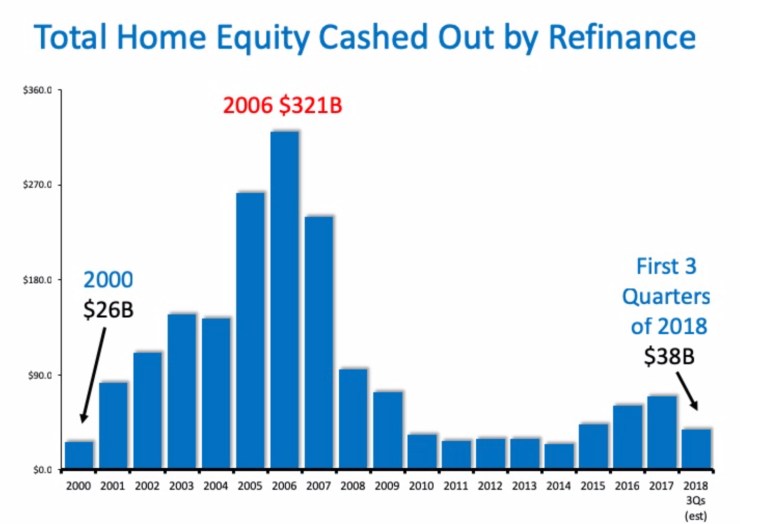
Ten years ago, many homeowners irrationally converted much, if not all, of their equity into cash with a cash-out refinance. When foreclosures rose and prices fell, they found themselves in a negative equity situation where their homes were worth less than their mortgage amounts. Many just walked away from their houses which led to even more foreclosures entering the market. Today is different. Over forty-eight percent of homeowners have at least 50% equity in their homes and they are not extracting their equity at the same rates they did in 2006.

Four Reasons Not to Fear a Housing Crash in 2019 (Part 1 of 4)

There is a lot of uncertainty regarding the real estate market heading into 2019. That uncertainty has raised concerns that we may be headed toward another housing crash like the one we experienced a decade ago.

Here is the first of four reasons why today’s market is much different:

There are fewer foreclosures now than there were in 2006


Number of Foreclosures.jpg

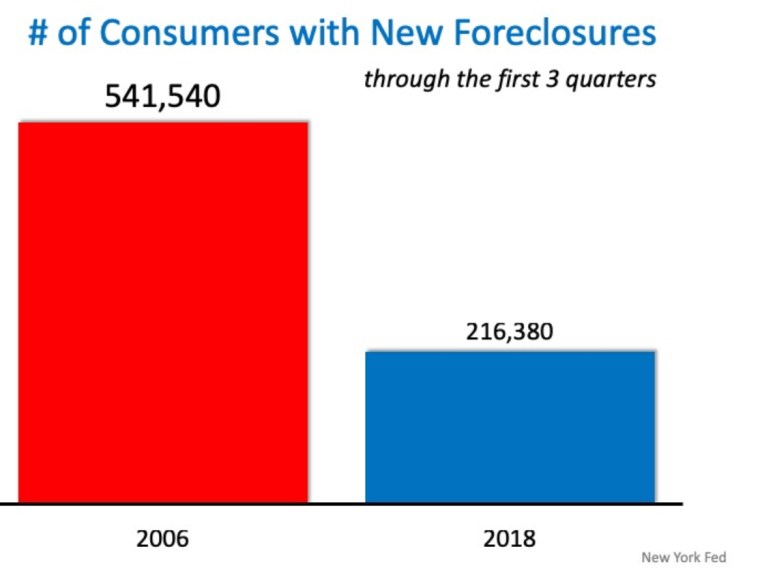
A major challenge in 2006 was the number of foreclosures. There will always be foreclosures, but they spiked by over 100% prior to the crash. Foreclosures sold at a discount and, in many cases, lowered the values of adjacent homes. We are ending 2018 with foreclosures at historic pre-crash numbers – much fewer foreclosures than we ended 2006 with.

Another Type of Financing Concession

Another Type of Financing Concession

Price, condition and terms are factors that any owner must consider when marketing their home.  Price is usually the easiest to adjust to compensate for shortcomings in location or condition of the home.  Improving the condition of the property is more time consuming but updates to kitchens, baths and other things can appeal to a buyer.

One of the most overlooked marketing factors are terms which are also referred to as financing concessions.

Paying part or all a buyer’s closing costs is the most common financing concession.  By doing so, the buyer doesn’t need as much cash to get into the home which can be attractive to more buyers.

There is another financing concession that is not used very often in today’s market but it is still allowed and can increase the marketability of a home. A temporary buy-down of the interest rate makes a lower payment for an initial period.

It is still a fixed-rate mortgage that the buyer must qualify for at the note rate and there is no negative amortization.  The seller pre-pays the interest in advance at closing so the buyer has lower payments in the initial period.

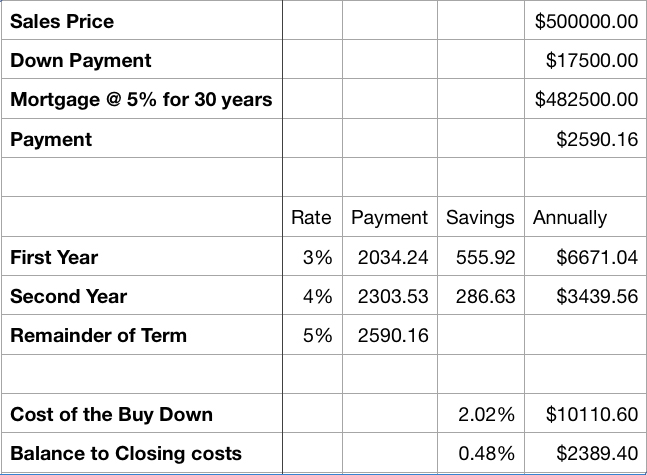
Instead of lowering the price of the home, let’s say the seller has decided to offer $12,500 worth of financing concessions that the buyer can apply any way they want.  One way might be to get a 2/1 buy-down which means that the first year, the payment would be based on 2% less than the note rate of the mortgage and the second year, it would be 1% less than the note rate.  The third through thirtieth years, the payment would be the actual note rate.

On a $500,000 home with a 3.5% down payment at 5% for 30 years, the first year’s mortgage payment would be figured at 3% which would be $555.92 less than normal.  The second year’s payment would be figured at 4% and would be $286.63 less than normal.  The third through thirtieth years, the payment would be the normal payment of $2590.16.Screen Shot 2018-12-20 at 11.37.55 AM copy.jpg

It would save the buyer $10,110 in interest in the first two years and there would still be $2,389 of the financing concession to apply toward the buyer’s closing costs.

The financing concessions paid by the seller give the buyer lower payments for the first two years and less money needed for the closing cost.  An added bonus for the buyer is that the buyer can deduct the pre-paid interest the seller paid as qualified mortgage interest.

Some lenders may tell you that temporary buy downs cannot be done.  They’ve been around for over thirty years and can still be done today on FHA, VA and conventional loans.  Call (206) 979-9632 if you need a recommendation of a trusted mortgage professional or check out a 2/1 Buydown with your own numbers.

Real Estate taxes are going up in San Juan County.

% Increase.jpg

Real Estate taxes are going up in San Juan County.

In San Juan County, where there is a 7.9 month supply of homes on the market (King County is 2.3 months) it is getting more expensive for Buyers to purchase a home.

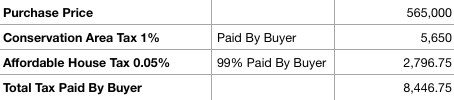
The county already imposes a Conservation Area Real Estate Tax equal to 1% of the purchase price to be paid by the Buyer at the time of closing.  Now the county has added an Affordable House Excise Tax equal to 0.5% of the purchase price.  The law states the new tax shall be paid 99% by the Buyer and 1% by the Seller.

In November 2018 the median selling price of a home in San Juan County was $565,000.  The combined affect of these taxes raises the purchase price for a Buyer as follows: 

Screen Shot 2018-12-21 at 8.56.55 AM copy.jpg

Smart Home Technology

More Comfortable, Convenient and Secure

Smart home technology promises to make your home more comfortable, convenient and secure.  It may not be the home from the Jetson’s but artificial intelligence is the hope to make it the home of the future which is available now and controlled from anywhere you have an Internet connection.

When Alexa appeared at Christmas-time two years ago, most people thought it was a novelty to ask what the weather will be or to play a song.  Few people understood the vision of Amazon would be verbally purchasing everything imaginable and that your calendar, contacts, lights, and appliances would all be connected.

There are plenty of players in the market including Amazon Alexa, Google Assistant, Samsung Smart Things, Apple and others.  It starts with a hub that acts like a brain for your system to connect the different home automation devices.  You’ll establish an online account with the hub manufacturer so that you can adjust settings and controls.

You could start simple with switch and plug receptacles that would allow you to control lights either vocally through your hub or from your Smartphone or tablet anywhere in the world where you have an Internet connection.

Programmable thermostats can lower your monthly utility costs while conveniently regulating your comfort by adjusting temperatures on your heating and cooling systems.  These can be particularly effective in homes with zoned systems where you might live in one area during the day but sleep in a different zone.

Door bells might be one of the next additions to your automation.  Not only can you communicate with the person at your door, you don’t have to go to the door to do it.  The device cameras are motion activated so you’ll see who is there regardless of whether they rang the doorbell or not.

Door locks can be convenient because instead of giving someone a key, you can issue a temporary code to let them enter.  You can give them permanent access and rescind it any time you want without having to change the locks.  You’ll know when they enter and leave your home.

Other security options can include door and window sensors, motion detectors and cameras for outside or inside the home.  The homeowner will be able to monitor from inside or anywhere else they have an Internet connection.

Smoke and carbon monoxide detectors, as well as water sensors to determine leaking water around water heaters or in basements give homeowners peace of mind.

Most of these devices are available in wireless models so you won’t have to string wire throughout the home.  The Wi-Fi can introduce a potential problem of hackers who could illegally access your system.  This is true with any home that has a Wi-Fi router and precautions should be taken.

The big box stores like Lowes, Home Depot, and Amazon offer a wide variety of brands and modules.  Many people prefer it as a do-it-yourself project and others would rather have a professional do it for them.  YouTube has a lot of videos that can probably show you exactly how to install the ones you select.

Do You Know the Way?

Do You Know the Way?

It may be natural for first-time buyers to be unsure of the process of buying a home because they haven’t been through it before but even repeat buyers need to know changes that have taken place since the financial housing crisis.

The steps in the home buying process are predictable and generally follow the same pattern.  It certainly makes the move stay on schedule when you know all the different things that must be done to get to the closing.

  • In the initial interview with your real estate professional, you share the things you want and need in a home, discuss available financing and learn how your agent can represent you in the transaction.
  • The pre-approval step is essential for anyone using a mortgage to purchase a home to assure that they’re looking at the right price of homes and so they’ll know what they can qualify for and what the interest will be.
  • Even with lower than normal inventory, it is difficult to stay up-to-date with the homes currently for sale and the new one just coming on the market.  Technology has simplified this process, but the buyer needs to implement them.  Typically, your Realtor will start a search based on the criteria you indicated was important.  Likewise, buyers typically establish online searches.  We recommend you share any listings you find interesting with your Realtor so your Realtor can fine tune their search based on your changing desires.
  • Your real estate professional can work with you to see all the homes on the market regardless of whether they are listed by real estate brokers, offered by builders or for sale by owners.
  • When a home has been identified, an offer is written and the negotiations over price, condition and terms takes place.
  • A contract drafted by your Realtor is a fully negotiated, written agreement.
  • Escrow is opened to deposit the earnest money from the buyer as a sign they are acting in good faith.  Earnest money may also represent liquidating damages paid to the seller in the event the buyer is in default of a term of the contract.  A title search is also started so that clear title can be conveyed from the seller to the buyer and that the lender will have a valid lien on the property.
  • 88% of home sales involve a mortgage.  The lender will require an appraisal to be sure that the home can serve as partial collateral for the loan.  If the buyer has been pre-approved, the verifications will be updated to be certain that they’re still valid and that they buyer still qualifies for the loan.  The entire loan package when completed, is sent to underwriting for final approval.
  • When the contract is completed, at the same time the title search and mortgage approval is being worked on, the buyer and buyer’s Realtor will arrange for any inspections that were called for in the contract.
  • After all contingencies have been completed, the transaction goes to settlement where all of the necessary papers (loan documents) are signed, and the balance of the buyer’s money is paid.
  • Title transfers from the seller to the buyer on the date of closing that is specified in the sales contract.
  • Possession occurs according to the terms of the sales contract and may or may not be on the same day as closing.

One of the responsibilities of your real estate professional is to make sure that things are done in a timely manner so that the transaction will close according to the agreement on time and without unforeseen or unnecessary problems.

Even if you’re not ready to buy or start looking yet, you need to be assembling your team of professionals.  Let us know and we’ll send you our recommendations, so you can read about them on their websites.

If you have any questions, call us at (206) 979-9632; we’re happy to help.  Informed buyers lead to satisfied homeowners and that is better for everyone involved.

Roll the Repairs into the Mortgage

It’s been said that if you can find a home that has most of what you want, you should go ahead and purchase it.  Many first-time buyers are using everything they have for a down payment and closing costs and would have to “live” with the less than perfect home until they can save the money to make the changes.

The FHA 203(k) mortgage allows a borrower to purchase a home and provides additional funds for improvements to be made.  These types of renovations can include kitchen and bathroom remodels, flooring, plumbing, heating and air conditioning systems, additions and other things.

The benefit to the buyer is that they have the opportunity to consider a home that needs repairs and might have been unacceptable without a program like this.  Being a FHA loan, a minimal down payment is required, fair interest rates and generous qualifying requirements.

The 203(k) Streamline can be used for cosmetic improvements, appliances and minor remodeling up to $35,000 in cost.

As you can imagine, this is a specialized program and not all lenders choose to make 203(k) loans.  They usually take longer to process and getting firm bids on the work to be done will be required.  It is important to find out how much experience a lender has with this particular type of loan.

It will also be required that you work with a 203(k) consultant in addition to the mortgage officer.

For more information, go to Hud.gov.  FNMA has a similar conventional loan program called HomeStyle Mortgage.  Your real estate professional will be able to help with recommendations.  Call me at (206) 979-9632.