Page 10 of 12

Consumer Protection from Irresponsible Mortgage Practices

Consumer Protection from Irresponsible Mortgage Practices

Congress enacted the Dodd-Frank Act in 2010 in response to the mortgage crisis that led to America’s Great Recession.  The two parts that apply closely to homebuyers are the Ability-to-Repay (ATR) and Qualified Mortgages (QM).

A Qualified Mortgage is a category of loans that have certain, more stable features that help make it more likely that borrowers will be able to afford their loan.  These loans do not allow certain risky features like an interest-only period when no money is applied to reduce the principal; negative amortization that would allow the mortgage balance to increase; and, “balloon payments” at the end of the loan that are larger than the normal periodic payments.

A debt-to-income ratio of less than or equal to 43% has been established to provide a limit on how much of a borrower’s income can go toward total debt including the mortgage and all other monthly debt payments.  However, the Consumer Finance Protection Bureau believes these loans should be evaluated on a case-by-case basis and in some cases, can exceed 43%.

There is a limit for up-front points and fees the lender can charge.

By showing that the lender made an effort to be certain that the borrower has the ability to repay the loan, the lender in turn, receives certain legal protections.  Underwriting factors considered by the lender include:

  1. current or reasonably expected income or assets
  2. current employment status
  3. the monthly payment on the covered transaction
  4. the monthly payment on any simultaneous loan
  5. the monthly payment for mortgage-related obligations
  6. current debt obligations, alimony, and child support
  7. the monthly debt-to-income ratio or residual income
  8. credit history

For more information, see the Consumer Financial Protection Bureau fact sheet … protecting consumers from irresponsible mortgage lending.

Act Decisively

Act Decisively

Whether it is hesitation or procrastination due to uncertainty, it can cost buyers by having to pay more for both the house and the financing.  This is one of those markets where most of the experts expect interest rates and prices will continue to rise through 2019.

The National Association of REALTORS? reports there is currently a 4.2-month supply of homes for sale which is close to the same as last year’s inventory.  Normal inventory is considered to be a 6-month supply.  In King County there is approximately a 1.7-month supply of homes.

If during the period you’re waiting to buy, the price of the home goes up by 5% and the mortgage rate (4.8%) increases by 1%, the payment on a $500,000 home with a 95% mortgage could be $434.27 more each and every month.  Over a seven-year period, the delay to purchase would total close to $36,500.

To act decisively, you need good information; a confused mind will not generally make a decision.  In today’s market, you need to know exactly what price home you can qualify for and you need to know what kind of home you can expect for that price.

You’ll want a housing and a mortgage professional you can trust to give you the information you need to make good decisions for yourself and your family.  We’d like to be your real estate professional and can recommend a trusted mortgage professional.

To get a better idea about what it may cost you for a home in your price range, use the Cost of Waiting to Buy calculator.  If you have any questions, call me at (206) 979-9632.

Moisture & Mold

Moisture & Mold

Moisture is mold’s best friend and it thrives between 40 and 100 degrees Fahrenheit which is why it is commonly found in homes.  Mold spores float in the air and can grow on virtually any substance with moisture including tile, wood, drywall, paper, carpet, and food.

Moisture control and eliminating water problems are key to preventing mold. Common sources of moisture can be roof leaks, indoor plumbing leaks, outdoor drainage problems, damp basements or crawl spaces, steam from bathrooms or kitchen, condensation on cool surfaces, humidifiers, wet clothes drying inside, or improper ventilation of heating and cooking appliances.

  • Control the moisture problem
  • Scrub mold off hard surfaces using soap and water or other cleanser; dry completely
  • Do not paint or caulk moldy surfaces
  • Discard porous materials with extensive mold growth
  • Avoid exposing yourself or others to mold
  • Periodically, inspect the area for signs of moisture and new mold growth

The EPA suggests that if the moldy area is less than ten square feet, you can probably handle the cleanup yourself.  If the affected area is larger than that, find a contractor or professional service provider.

Increasing ventilation in a bathroom by running a fan for at least 30 minutes or opening a window can help remove moisture and control mold growth.  After showering, squeegee the walls and doors. Wipe wet areas with dry towels.  Cleaning more frequently will also prevent mold from recurring or keep it to a minimum.

A simple solution to clean most mold is a 1:8 bleach/water mixture.  Since homes have thermostatically controlled temperatures and water is used all day long in the kitchen and bathrooms, the environment is conducive to mold.

See Ten things you should know about mold written by the EPA.

Reducing Taxes When It’s Time To Sell

Overlooked Record keeping

38285944-250.jpg


Homeowners are familiar that they can deduct the interest and property taxes from their income tax returns. They also understand that there is a substantial capital gains exclusion for qualified sales of up to $250,000 if single and $500,000 for married filing jointly. However, ongoing recordkeeping tends to be overlooked.

New homeowners should get in the habit of keeping all receipts and paperwork for any improvements or repairs to the home. Existing homeowners need to be reminded as well, in case they have become lax in doing so.

These expenditures won’t necessarily benefit in the annual tax filing but may become valuable when it is time to sell the home because it raises the basis or cost of the home.

For instance, let’s say a single person buys a $350,000 home that appreciates at 6% a year. Twelve years from now, the home will be worth $700,000. $250,000 of the gain will be exempt with no taxes due but the other $100,000 will be taxed at long-term capital gains rate. At 15%, that would be $15,000 in taxes due.

Assume during the time the home was owned that a variety of improvements totaling $100,000 had been made. The adjusted basis in the home would be $450,000 and the gain would only be $250,000. No capital gains tax would be due.

Some repairs may not qualify as improvements but if the homeowner has receipts for all the money spent on the home, the tax preparer can decide at the time of sale. Small dollar items can really add up to substantial amounts over many years of homeownership.

You can download a Homeowner’s Tax Worksheet that can help you with this recordkeeping. The important thing is to establish a habit of putting receipts for home expenditures in an envelope, so you’ll have it when you are ready to sell.

It Is All In The Name 

It Is All In The Name

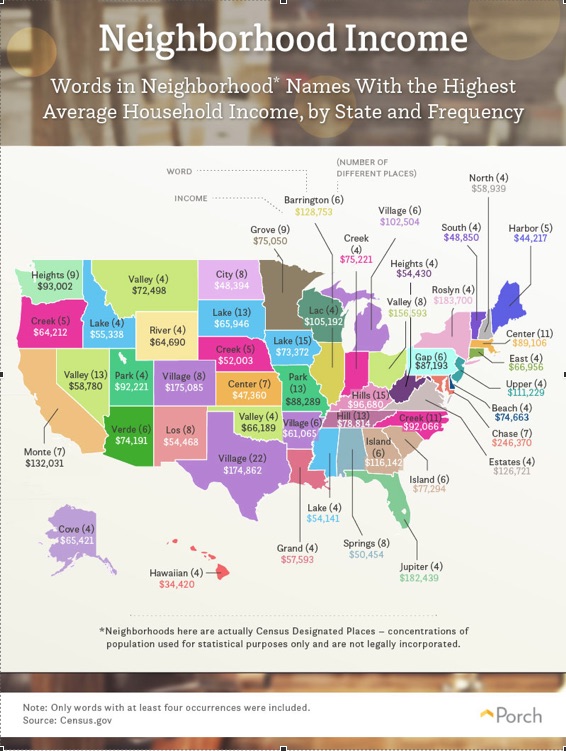
You may be able to judge a neighborhood by its name. Some neighborhoods containing certain names tend to attract the wealthiest residents and boast the highest home values, according to a new study by Porch.com, a home improvement resource.

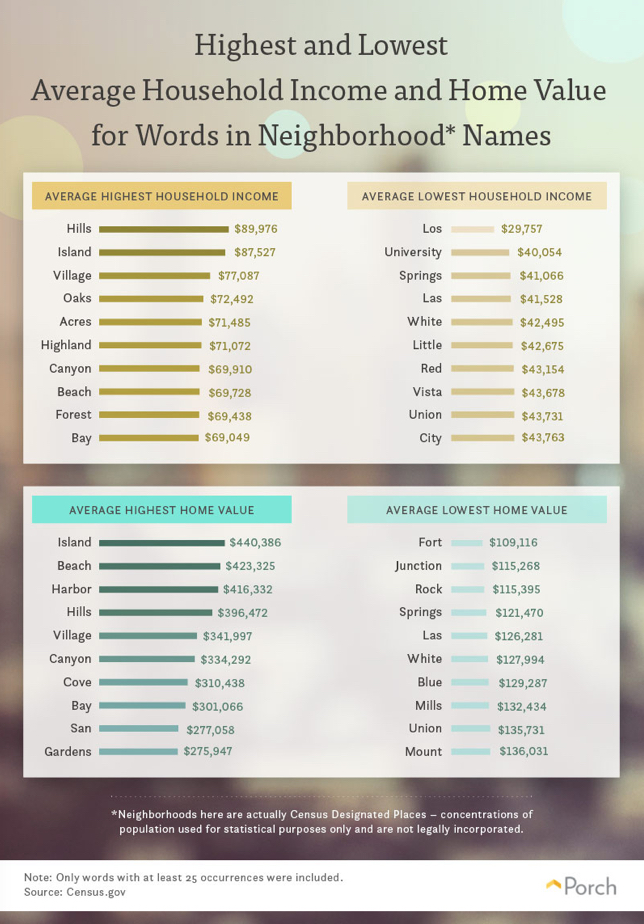
Neighborhoods that include names like “Hills,” “Island,” and “Village,” for example, tend to report some of the highest average household incomes in the country. On the other hand, the lowest home values were found in neighborhoods with words like “Fort,” “Junction,” and “Rock” in their names.

In the richest neighborhoods, researchers found places that had names using the words “Village,” “Valley,” and “Heights” tended to exceed $100,000 in average household incomes. For example, in Texas, 22 neighborhoods and communities that contained the name “Village” had average household incomes of more than $174,000. Colorado and Michigan communities that contained the word “Village” in the name also contained some of the states’ wealthiest residents, too.


Neighborhood Income.jpg

Porch researchers looked at the neighborhoods with the highest incomes and home values in each state. View the chart below for a breakdown of each state’s neighborhood name that boasted the highest average incomes.  

Highest and Lowest Names

What to Avoid Before Closing Your New Home

What to Avoid Before Closing Your New Home

It’s understandable; you’re excited; you’ve found the right home, negotiated a contract, made a loan application and inspections.  Closing is not that far away, and you are making plans to move and put personal touches on your new home.

Even if you have an initial approval on your mortgage, little things can derail the process which isn’t over until the papers are signed at settlement and funds distributed to the seller.  The verifications are usually done again just prior to the closing to determine if there have been any material changes to the borrower’s credit or income that might disqualify them.

Most lending and real estate professionals recommend NOT to:

  • Make any new major purchases that could affect your debt-to-income ratio
  • Buy things for your new home until after you close
  • Apply, co-sign or add any new credit
  • Close or consolidate credit card accounts without advice from your lender
  • Quit your job or change jobs
  • Change banks
  • Talk to the seller without your agent

Your real estate professional and lender are working together to get you into your new home.  It’s understandable to be excited and feel you need to be getting ready for the move.

Planning is fine but don’t do anything that would affect your credit or income while you’re waiting to sign the final papers at settlement.